Whole Cube Formula: Calculator, Proof & Examples
The whole cube formula expands the cube of a sum or difference. Get the identity immediately, then calculate a numerical example and see why the 1–3–3–1 pattern works.
Written and checked by TheToolNet Editorial Team · Last reviewed: August 20, 2026 · How we check math content
It can also be written as a³ + b³ + 3ab(a + b). For subtraction:
Whole Cube Formula Calculator
Enter two real numbers. Choose plus or minus to calculate the cube and display each term in the identity.
What does “whole cube” mean?
“A plus b whole cube” means the entire binomial (a + b) is raised to the third power. In other words, multiply the complete bracket by itself three times:
(a + b)³ = (a + b)(a + b)(a + b)
The word whole matters. The exponent applies to both terms and to their interaction. That is why cubing a sum produces four terms—not just a³ + b³.
The powers follow an orderly pattern. The power of a falls from 3 to 0, while the power of b rises from 0 to 3. The coefficients are 1, 3, 3, 1:
| Term | Coefficient | Powers |
|---|---|---|
| a³ | 1 | a³b⁰ |
| 3a²b | 3 | a²b¹ |
| 3ab² | 3 | a¹b² |
| b³ | 1 | a⁰b³ |
How to derive the whole cube formula
You do not have to memorize the identity blindly. Start with the familiar square formula and multiply once more by (a + b).
- Write the cube as a square times the binomial:
(a + b)³ = (a + b)²(a + b) - Use the square identity:
= (a² + 2ab + b²)(a + b) - Distribute every term:
= a³ + a²b + 2a²b + 2ab² + ab² + b³ - Combine like terms:
= a³ + 3a²b + 3ab² + b³
The compact form comes from factoring the two middle terms: 3a²b + 3ab² = 3ab(a + b). Therefore, (a + b)³ = a³ + b³ + 3ab(a + b).
Geometric proof using a cube
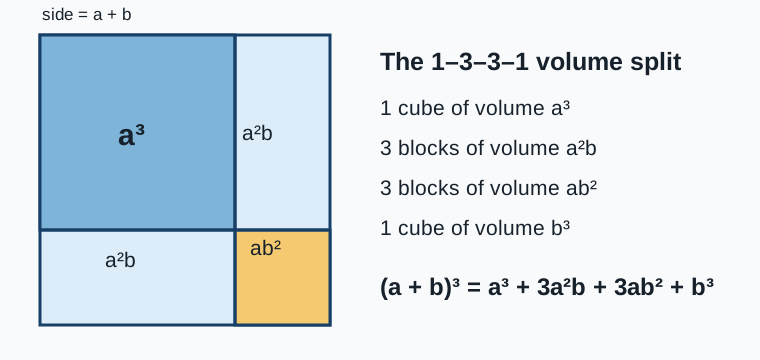
Imagine a large cube whose side length is a + b. Its volume is (a + b)³. Cut each dimension at distance a. The pieces have these volumes: one a³ cube, three a²b cuboids, three ab² cuboids, and one b³ cube.
Solved whole cube formula examples
Example 1: Find (5 + 2)³
Let a = 5 and b = 2:
5³ + 3(5²)(2) + 3(5)(2²) + 2³
= 125 + 150 + 60 + 8 = 343
Example 2: Expand (2x + 3y)³
Treat the complete terms 2x and 3y as a and b:
(2x)³ + 3(2x)²(3y) + 3(2x)(3y)² + (3y)³
= 8x³ + 36x²y + 54xy² + 27y³
This is where keeping brackets around each full term prevents lost coefficients.
Example 3: Calculate (10 − 2)³
For subtraction, use a = 10 and treat b = −2 in the plus formula:
10³ − 3(10²)(2) + 3(10)(2²) − 2³
= 1000 − 600 + 120 − 8 = 512
Example 4: Use the formula for mental math
To cube 101, write it as (100 + 1)³:
100³ + 3(100²)(1) + 3(100)(1²) + 1³
= 1,000,000 + 30,000 + 300 + 1 = 1,030,301
Common mistakes and quick checks
The two middle terms are missing. A quick counterexample is a = b = 1: the left side is 8, while the incorrect right side is only 2.
The correct signs alternate: plus, minus, plus, minus. You can safely replace b with −b in the plus formula and simplify.
In (2x + 3y)³, cube the complete terms: (2x)³ = 8x³ and (3y)³ = 27y³.
Three ways to check an expansion
- The coefficients should be 1, 3, 3, 1.
- Every term should have a total degree of 3.
- Substituting simple values such as a = 1 and b = 1 should make both sides equal.
Frequently asked questions
What is the whole cube formula?
The a plus b whole cube formula is (a + b)³ = a³ + 3a²b + 3ab² + b³. The a minus b form is (a − b)³ = a³ − 3a²b + 3ab² − b³.
Is (a + b)³ equal to a³ + b³?
No. Cubing a sum creates the middle terms 3a²b and 3ab². The expressions are equal only in special cases where 3ab(a + b) = 0.
How do I remember the whole cube formula?
Remember 1–3–3–1. Decrease the power of a from 3 to 0 while increasing the power of b from 0 to 3. For (a − b)³, alternate the signs.
What is the difference between whole cube and sum of cubes?
(a + b)³ is a bracket being cubed and must be expanded. The expression a³ + b³ is already a sum of two cubes and can be factored as (a + b)(a² − ab + b²).
Can the formula use numbers, variables, or expressions?
Yes. Each of a and b can be a number, a variable, or a larger expression. Keep the full substituted term in brackets before applying powers.
Sources and review notes
The identity is verified above by direct multiplication and by a geometric volume decomposition. For broader reference, see the Binomial Theorem at Wolfram MathWorld and the binomial theorem overview. Found an error or unclear step? Please use our correction channel.